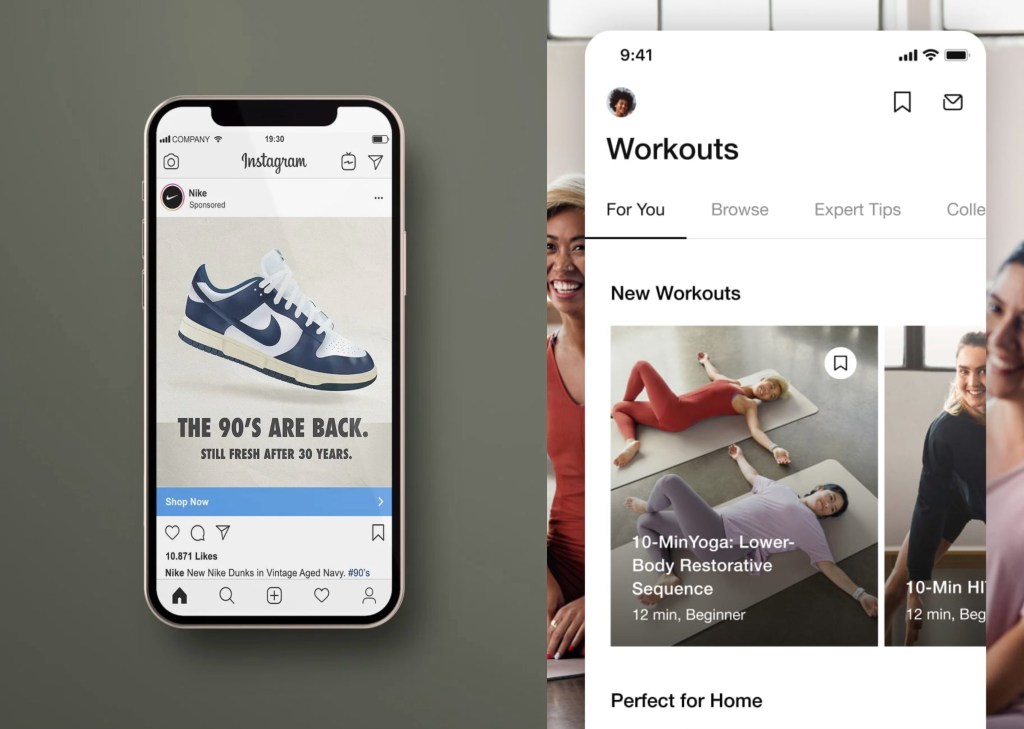
In digital marketing, Push and Pull are often regarded as two “opposite” strategies: one actively pushes you, and the other attracts you. But what’s truly interesting is that excellent brands usually don’t have to choose between the two; instead, they use both as a combined strategy. Taking Nike as an example, we can see the differences between Push and Pull from two very typical pictures: one is the Sponsored advertisement on Instagram (Push), and the other is the content interface of Nike Workout App (Pull). Both are the ways for the brand to reach users, but their core strategies, target audiences, and measurement indicators are completely different.
Instagram Sponsored: The core of Push is “buying attention + quick conversion”
Instagram sponsored advertisements belong to the typical Push / Outbound / Paid Social. They appear during users’ scrolling through their feeds, essentially a “interrupted” form of communication: Users don’t actively seek Nike, but Nike uses paid placement to insert information in front of them. Therefore, the strategic goal of Push is very clear – using paid traffic to seize attention and drive quick sales. In such advertisements, Nike often uses a combination of strong visuals, strong emotions, and strong call-to-action, such as large shoe images, retro-themed copy “The 90’s are back”, using Nostalgia Marketing (nostalgic marketing) to evoke trends and emotional memories, lowering users’ psychological barriers, and stimulating the impulse of “I want to buy now”. On Targeting, Instagram Push ads mainly target potential buyers (Cold/Warm Audience), such as sneaker lovers, streetwear fans, young consumers aged 18-35, and enthusiasts of trends and retro culture. These people may be “interested” in the products, but they may not be brand loyal. More importantly, the placement on social platforms usually includes behavioral targeting: for example, those who have visited Nike’s official website, searched for sneakers, clicked on similar ads, and purchased sports products are more likely to be reached again by Retargeting or Lookalike mechanisms, thereby increasing the conversion probability. In other words, the core of Push is not “waiting for users to come”, but to actively draw users into the purchase scenario using data and budget.
Nike Workout App: The core of Pull is “first provide value, then build loyalty”
In contrast, the content pages of Nike Workout App represent another logic: Pull / Inbound / Content + Platform. The prerequisite for users to enter the App is “I want to work out” “I want to find training content”, which means that consumers are the initiators of the behavior. In this case, Nike’s goal is not to sell shoes immediately, but to build relationships by continuously providing value: first provide value → build trust → retain users → complete commercial conversion. In the “Targeting” aspect, the Nike Workout App is more inclined towards high-engagement users: regular exercisers, fitness beginners, those who aim for long-term exercise, Nike fans, etc. At the same time, it also demonstrates clear psychographic targeting: people who are concerned about health awareness, self-improvement, self-discipline, and lifestyle-oriented. Because for these users, Nike is not “buying a pair of shoes”, but “joining a lifestyle”. When users gain value from the content and training experience, the brand’s influence will be deeper, more lasting, and easier to turn into long-term purchases and brand loyalty.
In a nutshell: Nike attracts high-engagement users through personalized fitness content in the App, establishing long-term relationships and brand loyalty.
When you look at the two diagrams together, you will notice that they respectively cover different stages of the consumer journey: Push is better at reaching consumers quickly and acquiring new customers, while Pull is better at interaction and retention. Push can quickly generate buzz and bring in short-term sales during new product launches or promotions; Pull, on the other hand, cultivates habits through content and experiences, turning one-time users into sustainable relationships. In reality, Nike’s growth logic is often “combinatorial”: Push brings people in, and Pull keeps them; Push is responsible for short-term efficiency, while Pull is responsible for long-term assets. This is why many brands are increasingly emphasizing their own platforms (Apps, membership systems, content matrices) in the digital age: because Pull can turn users from “platform traffic” into “brand’s own users”.
James Chen
02/03/2026
 James Chen | Marketing Notes
Leave a comment